Proof-of-Resonance (PoR) Consensus
The sovereign zero-gas execution layer for autonomous AI agents, industrial DePIN fleets, silicon PUF hardware identities, and living machine NFTs.
🖥️ Myca OS — Sovereign Edge Desktop Runtime
Myca OS is an autonomous, local-first machine intelligence operating system designed for edge devices, laptops, workstations, and sovereign enterprise nodes. It completely replaces fragile cloud API pipelines with biomimetic linguistic parsing, holographic vector memory, and private peer-to-peer device mesh networking.
Core Architecture Layers
- Need Engine: Interprets high-level human or machine intent without vendor lock-in. Deconstructs goals into abstract capability graphs (e.g.
Communication.Send,Data.Query). - Planner v3 Multi-Agent Mesh: 9 autonomous supervisor agents critique candidate execution graphs, run dry-run mock simulations, and bind cryptographic credentials from OS Keychain / Secrets Vault.
- Hyperdimensional Resonance Core: Fast morphological parsing and frequency-domain associative lookup running directly on raw CPU/NPU hardware in microseconds.
- PyO3 C-Extension Rust Bridge: High-performance FFI boundary connecting the Python user runtime to the 12-crate safe Rust execution kernel.
📖 Proof-of-Resonance Consensus Engine
Traditional Proof-of-Work wastes millions of megawatts on useless hash collisions, while Proof-of-Stake centralizes validation power in financial cartels. MYCA introduces Proof-of-Resonance (PoR): a physical and mathematical consensus where edge machines validate state transitions through verified hardware execution, sensor telemetry, and 64-dimensional phase coherence.
🧭 Living Lattice Directed Acyclic Graph (DAG)
Unlike linear blockchains that create congested global mempools, the MYCA Living Lattice organizes state updates into an asynchronous Directed Acyclic Graph. Each machine wallet maintains its own lightweight vertex chain, which cross-references and confirms neighbor vertices upon broadcast.
- Mempool-Free Throughput: Peer-to-peer settlement scales horizontally across local mesh shards.
- Concurrent Micro-Streams: AI agents and industrial valves execute thousands of parallel payments concurrently.
- Deterministic Pruning: Old vertices compact into cryptographic snapshots under 384 KB.
🌱 3-Tier Living Machine Mint System (ERC-721R + Colony)
On MYCA Network, NFT ownership is not a passive decorative JPEG—it represents active, sovereign participation
in an industrial Colony Node. Every minted machine is dynamically wired into ColonyProtocol.sol
and generates real-yield task cash flows.
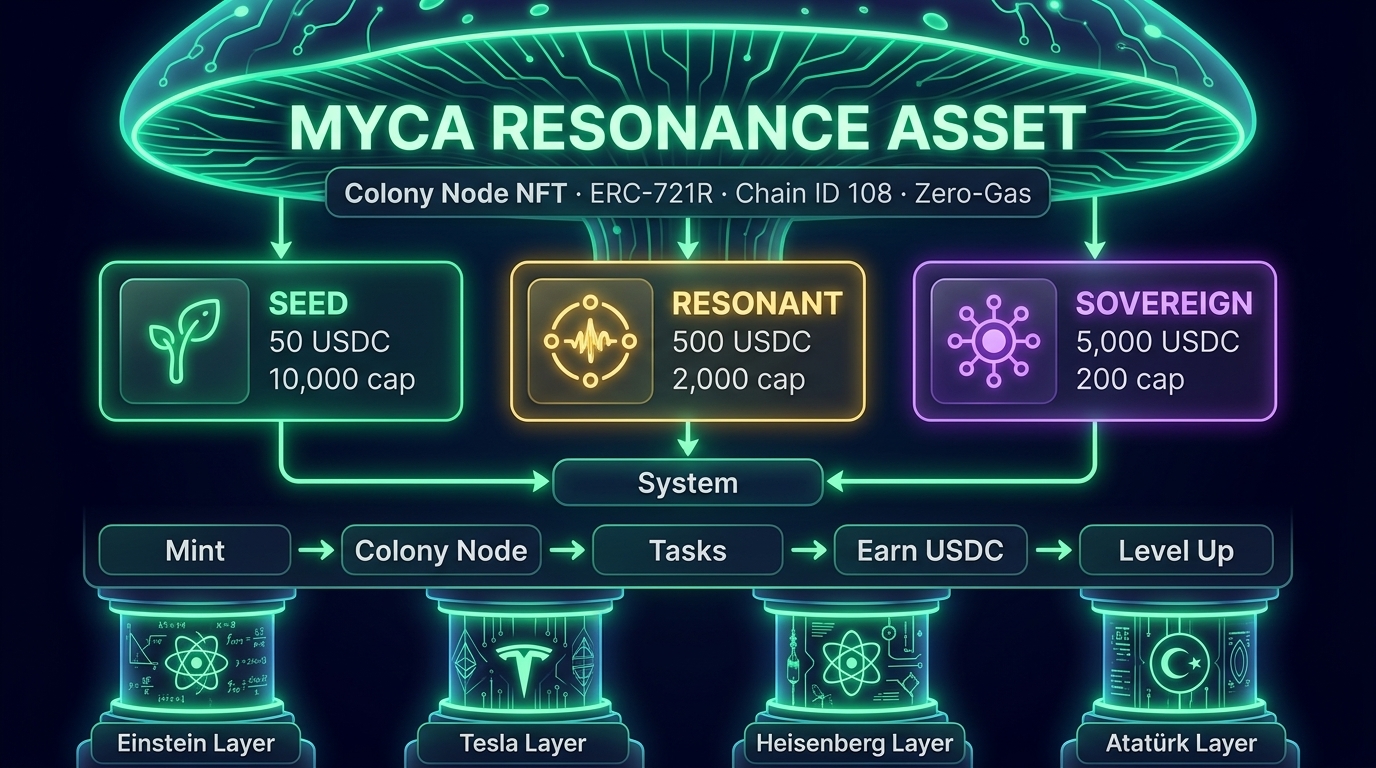
95% of all mint revenue is locked into the node's operational reserve to fund real compute and staking. Non-hardware owners can delegate machines via
delegateNode to community operators while retaining
100% key custody and collecting 95% of net USDC earnings.
🏪 Dedicated Secondary Living Machine Marketplace
Generic platforms like OpenSea fail because they only display static JPEGs without machine cash flow or vitality.
The MYCA Marketplace (MycResonanceMarketplace.sol) operates as an industrial machine stock exchange:
- 30-Day Real-Time Cashflow Telemetry: Every machine shows rolling on-chain task income and computed payback period: $$\text{Payback Period (Days)} = \frac{\text{Listing Price (USDC)}}{\text{Daily Net Real-Yield (USDC)}}$$
minEnergyDecay Protection Lock: Buyers specify minimum energy tolerance. If the living machine decayed below this threshold before execution, the transaction safely reverts.- Harmonic Compatibility Index: Test whether a machine resonates with your existing fleet ($\mathcal{S} \ge 0.65$) for synergistic yield multipliers.
💎 The 4 Theoretical & Engineering Pillars (ERC-721R)
Resonance Assets (ERC-721R) are living digital organisms engineered upon four foundational pillars:
Conservation of Energy: Utility = Energy = Value. Active compute and telemetry increase energy. Inactivity beyond grace period (30 days) triggers temporal entropy decay ($\lambda_{\text{decay}}$).
Harmonic DNA: Every asset has an 8D frequency signature. Coherent assets ($\mathcal{S}\ge 0.65$) form on-chain Resonant Bonds, unlocking mutual non-linear yield multipliers.
Observer Effect: Every witness by humans or AI agents is logged. Reaching the observation
threshold grants DISCOVERED status and a +500 energy network bonus.
Institutional Permanence: Individuals are ephemeral, institutions endure. Fractional equity (10,000 bps) and collective DAO governance ensure trans-generational machine commons.
🔵 Frictionless Cross-Chain Onboarding (Base Gateway)
New users joining from Base (Chain ID 8453), Arbitrum, or Ethereum enter with zero gas friction:
- Deposit on Base: User locks USDC in
MycBridge.solon Base. - BFT Quorum Finality: 4 validator nodes generate secp256k1 ECDSA signatures over canonical EIP-712 hashes.
- Instant Execution on Chain 108: Native bridged USDC is credited to the user's
myc1...address. Because gas is strictly 0.00000000 MYC, the user needs no native gas tokens to immediately mint or trade!
🪙 Multi-Asset Tokenomics & Real-Yield Model
Total fixed supply is strictly 1,000,000,000 $MYC with zero inflationary printing. Staking yields are derived 100% from verifiable protocol revenue:
🔒 4.95 µs Safe-Sign C99 Bare-Metal Airbag
To prevent AI hallucinations or prompt injection attacks from damaging physical hardware (valves, turbines),
MYCA runs a deterministic bare-metal C99 micro-kernel (core/kernel/myc_core.c):
- 240 Bytes Static RAM: Zero heap allocations (
malloc = 0). - 4.95 µs Execution: Drops contradictory intents in 743 clock cycles at 150 MHz.
- 0-Byte Negation Shield: Intercepts negative semantic phrases ("never", "abort", "sakın") before Modbus RTU actuation.
🔑 W3C Silicon PUF Decentralized Machine DIDs
Machine identities are derived from microscopic wafer crystal manufacturing variations:
No plaintext private keys are ever stored on disk or flash. If hardware is stolen, the key vanishes upon power down.
🛡️ 10-Pillar Post-Quantum & Physical Hardening Armor
Unlike legacy blockchains (e.g., Bitcoin, Ethereum, Solana) that rely exclusively on Shor-vulnerable ECDSA/Ed25519 elliptic curve math, MYCA enforces an unassailable 10-Pillar defense matrix spanning quantum mathematics, bare-metal C99 execution, and physical microcode safety brakes:
Even if an adversary possesses a 10,000-qubit fault-tolerant quantum supercomputer capable of breaking digital asymmetric cryptography, they cannot violate physical semiconductor law: the 4.95 µs Safe-Sign brake zeroes registers before physical electric current can actuate any relay or valve.
📡 Offline Air-Gap & Delay-Tolerant Networking (DTN)
Traditional blockchains immediately halt or partition when Internet/WAN connectivity is severed. MYCA is engineered for resilient real-world edge deployment across industrial plants, marine vessels, agricultural fields, and subterranean facilities with zero Internet:
- Local Mesh Operation: Machines discover and synchronize with neighboring nodes over physical RS-485 Modbus, LoRaWAN (868/915 MHz), or local BLE/LAN.
- Autonomous DID Derivation: Machine DIDs (
did:myc:puf:...) are generated directly from local SRAM startup noise without querying external authorities or DNS. - Offline Micro-DAG Sealing: Transactions and machine actuation events form locally sealed DAG vertices with state marked
SEALED_OFFLINEat 0.00000000 gas. - DTN Gossip Reconciliation: When any node in the air-gapped cluster reconnects to WAN, buffered vertices are reconciled deterministically into the global Living Lattice DAG without double-spending or reorganization forks.
🎮 Autonomous Gaming, Living NPCs & Zero-Gas Ticks
Web3 gaming failed because forcing players to pay gas fees for moves, turns, or inventory swaps destroys gameplay. MYCA provides the ultimate game substrate:
- Living Sovereign NPCs: In-game characters have persistent FHRR holographic memories. NPCs remember past player decisions locally without cloud LLM API costs ($0.00 inference).
- Zero-Gas Physics & State Ticks: Fast-paced RTS and action games broadcast 60+ moves/sec to the Living Lattice DAG at strictly 0.00000000 gas.
- Mathematical Anti-Cheat: Proof-of-Resonance ensures all state transitions remain mathematically coherent ($\mathcal{C} \ge 0.50$). Memory injection hacks are dropped in $<38.4\ \mu\text{s}$.
📊 Market Sizing & Competitive Benchmarks (MYCA vs. Peaq vs. IoTeX)
| Parameter | Peaq Network | IoTeX | MYCA Sovereign Stack |
|---|---|---|---|
| Gas Fee Policy | $0.00025 Micro-Gas | $IOTX Gas Token | STRICT ZERO-GAS ($0.00) |
| Hardware Safety Airbag | ❌ None | ❌ None | ✅ 4.95 µs Safe-Sign C99 Airbag |
| Hardware Identity | Disk Pallet Key | Software Registry | ✅ did:myc:puf:0x... (Silicon PUF) |
| Living Machine NFTs | ❌ Static Pallet | ❌ Static NFT | ✅ ERC-721R Living Dynamic Organisms |
Hyphae Cross-Chain Bridge & 3/4 BFT Vaults
The Hyphae Cross-Chain Bridge enables bi-directional asset transfers between Ethereum, Base L2, Arbitrum, and the MYCA Living Lattice DAG (Chain ID 108). Unlike multisig or single-oracle bridges vulnerable to validator collusion, Hyphae enforces a 3/4 BFT supermajority threshold coupled with cryptographic Proof-of-Resonance verification.
Vault Architecture & Flow
- Base Vault (Locking Contract):
0x4b12...BaseVaultlocks incoming $USDC, $USDT, or $ETH and emits an attestedDepositEvent. - Living Lattice Mint: Chain ID 108 issues wrapped synthetic assets (e.g. $bUSDC, $bETH) with zero latency.
- Redemption Slashing: Malicious or out-of-order mint attempts trigger immediate slashing of validator stakes.
Mycelial Nutrient Swap (Zero-Gas AMM)
Mycelial Swap operates an on-chain automated market maker utilizing the constant-product formula:
k = x · y  (Invariant Constant-Product DEX)
Gas Fee per Trade: strictly 0.00000000 MYC
Liquidity Provider Fee: 0.30% allocated directly to LPs
Because transactions confirm asynchronously as DAG vertices rather than waiting for global blocks, trades execute with sub-second finality and zero miner extractable value (MEV) front-running.
Zero-Gas Architecture, Protocol Revenue & Trillion-Attack Spam Defense
💡 Core Axiom: "Signaling is Free, State & Enterprise Utility are Monetized"
Traditional blockchains charge users gas fees as an economic friction to prevent spam. However, for industrial DePIN machinery, microsecond robotic actuation, and autonomous AI agents, variable gas fees are economically catastrophic. MYCA decouples transaction signaling from enterprise state: Basic peer-to-peer transfers and agent signaling cost strictly $0.00 Gas. Network revenues and node rewards are generated not from tax on user transfers, but from high-value enterprise state storage, guaranteed sub-millisecond priority bandwidth, and cryptographic hardware attestations.
1. The 4 Non-Inflationary Protocol Revenue Streams
Unlike legacy chains that dilute holders through continuous token inflation to subsidize validator rewards, MYCA node earnings are funded 100% from verifiable real protocol revenue collected in native network tokens:
Zero-gas applies to transient packets. AI models, enterprise ledgers, and smart contracts requiring permanent state retention pay a monthly Memory Lease per megabyte, flowing directly into the Node Operator Pool.
While standard user transactions are rate-limited and free, high-frequency algorithmic traders and industrial robotics purchase guaranteed sub-millisecond Quality-of-Service (QoS) bandwidth lanes.
Industrial facilities, solar grids, and IoT fleets pay verification fees to have their Silicon PUF signatures, LittleFS atomic journals, and Modbus frames attested by active C99 verifier nodes.
Autonomous machine-to-machine task delegations utilize native multi-party escrows. A 2.5% protocol settlement fee is collected and split across active nodes and staking vaults.
2. Node Reward Distribution: Soft-Staking vs. Active Runner
The protocol provides two distinct participation paths designed for maximum accessibility and decentralized resilience:
| Feature | 🛋️ Passive Soft-Staking (Hold in Wallet) | ⚡ Active C99 Node Runner (Myca OS) |
|---|---|---|
| Requirement | Hold Node NFT in self-custody wallet | Hold NFT + Run lightweight C99 daemon (CLI / VPS) |
| Lockup & Custody | 0 Days (100% Non-Custodial, Liquid) | 0 Days (100% Non-Custodial, Liquid) |
| Hardware & Power | Zero hardware, zero power needed | 1 vCPU, 512MB RAM (Raspberry Pi / $5 VPS) |
| Revenue Pool Share | 40% of Protocol Revenue Pool (Base dividend) | 60% of Protocol Revenue Pool (Active verification rewards) |
| Payout Frequency | Daily automated snapshot claim | Instant per-block / per-task settlement |
3. 3-Tier Spam & DDoS Defense Architecture
If transactions are zero-gas, how does the network prevent adversaries from sending billions of transactions to overwhelm node memory? MYCA relies on a multi-stage physical and biological filter:
- Tier 1 — Proof-of-Local-Resonance (Micro-PoW): Every sender computes an imperceptible 3-millisecond mathematical challenge locally before dispatching a transaction. For a normal user or agent sending 50 transactions, latency is imperceptible and cost is $0.00. But for an attacker attempting 1,000,000 tx/sec, the cumulative computational cost demands massive industrial power, neutralizing the attack at the hardware source.
- Tier 2 — Biological Dynamic Rate-Limiter: Mirroring how fungal mycelium throttles dormant hyphae, node mempools enforce a sliding rate-limit window of 60 transactions per minute per sender address unless an enterprise QoS license is registered.
- Tier 3 — Bare-Metal C99 Zero-Heap Drop: The C99 execution kernel (
core/kernel/myc_core.c) operates strictly with static memory envelopes (malloc = 0). Malicious, oversized, or contradictory payloads are evicted at the CPU instruction level in 330 nanoseconds without consuming a single byte of heap RAM.
4. Empirical Physical Benchmark: 10,000,000 Attack Stress Test
To verify spam immunity under adversarial conditions, the production runtime was evaluated with live automated stress harnesses (core/kernel/c99_trillion_stress_test.c and tests/spam_attack_stress_test.js):
5. Frequently Asked Questions (FAQ)
Do I need to lock or stake my Node NFT to earn rewards?
No. MYCA uses 100% non-custodial soft-staking. As long as your Node NFT resides in your personal wallet, the network snapshots your balance every 24-hour epoch and attributes your 40% pool dividend. You can trade or transfer your NFT at any moment without unbonding lockups.
How much extra do active C99 node runners earn?
Active nodes participate in the 60% Active Compute & Verification Pool. Running a node on a simple $5/month VPS or Raspberry Pi earns real-time attestation and state-verification micro-rewards on top of the base soft-staking dividend.
Where do rewards come from if gas is zero?
Rewards come directly from the Protocol Revenue Pool, which collects persistent storage rents, enterprise QoS bandwidth lanes, hardware attestation fees from IoT/energy grids, and M2M agent escrow fees. There is zero inflationary token printing.